The transition to 5G has fundamentally altered the performance expectations placed on the BSS layer. To meet the Ultra-Reliable Low Latency Communication (URLLC) targets of 3GPP standards, network functions like the Converged Charging System (CCS) are typically bound by strict response SLAs of <10ms.
When a charging system fails to authorize a session within that tiny window, the network operator is forced into a lose-lose scenario:
- Block the traffic: Deny the service, resulting in a degraded user experience and an upset subscriber.
- Allow the traffic: Permit the service without reserving quota, accepting silent revenue leakage.
Given the competitive nature of the telco market, networks typically default to the latter—prioritizing the subscriber and leaving the Revenue Assurance department to absorb the financial hit.
But why are state-of-the-art, cloud-native 5G systems missing these SLAs in the first place? It is not a failure of the 5G protocols; it is a failure of the underlying decision layers to obey the laws of physics.
The Geographical Race Condition (The Physics Problem)
To meet a <10ms SLA, charging requests must be serviced geographically close to the user.
Consider a deployment footprint the size of the United States. The laws of physics dictate the speed of light through fiber optics; the theoretical minimum round-trip time (RTT) from New York to Los Angeles is roughly 56 milliseconds. Over standard enterprise IP backbones, realistic coast-to-coast RTT sits between 65ms and 75ms.
Because of these physical limits, a centralized decision layer will instantly violate 5G SLAs. To achieve true national 5G coverage, operators must deploy at least three fully active instances: East, Central, and West.
But this introduces a massive data challenge.
Example: The 5G Shared Wallet Race Condition
Imagine a parent in New York and a college student in California simultaneously streaming video from their shared family plan. Their local charging instances must actively service those requests. Because it takes ~70ms for the East Coast database to update the West Coast database, both sites operate in good faith based on the balance state they currently see.
This exact scenario instantly breaks traditional decision layer architectures:
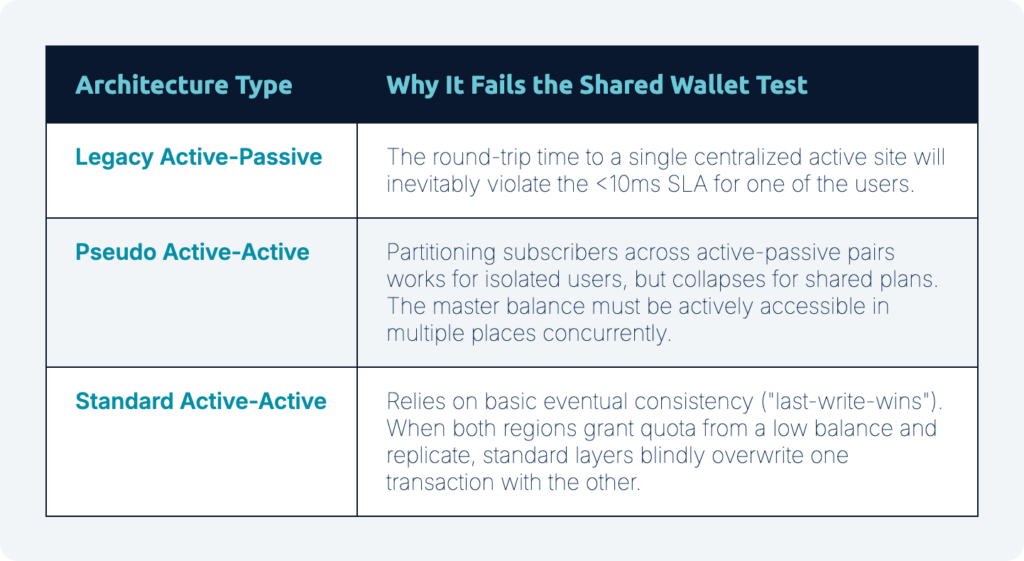
In that last example the system literally “forgets” one of the transactions, the shared quota is over-allocated, and the data is silently corrupted. The operator loses money and lacks the accurate audit trail required to understand why.
The Real-Time Decisioning Imperative
To manage geographical physics without sacrificing 5G SLAs or data integrity, charging platforms require an overarching, active-everywhere Real-Time Decisioning Layer.
Volt operates as the real-time meter and decision authority for mission-critical monetization systems. Here is how it solves the race condition at Tier 1 scale:
- ACID-Grade Consistency Under Extreme Load: Volt maintains the authoritative operational state in-memory and executes deterministic decision logic atomically. When multiple requests hit the same regional cluster concurrently, Volt ensures each request is evaluated sequentially against the absolute current state of the balance in millisecond timeframes, entirely eliminating local race conditions.
- Lossless XDCR (Active-Active-Active Architecture): Volt acknowledges that asynchronous replication across thousands of miles means temporary geographical conflicts are inevitable. Instead of silently overwriting data, Volt utilizes Cross Data Center Replication (XDCR) to guarantee lossless, deterministic conflict resolution.
- Actionable Conflict Resolution: When a geographic conflict is detected, Volt applies strict timestamp-based reconciliation for deterministic convergence. Crucially, it immediately packages the complete context of the conflict and passes it to the application layer. The operator can then apply bespoke business logic to correct the good-faith over-allocation—such as deducting the overage from the next billing cycle.
- Telco-Grade Continuity: Volt ensures 99.999% availability through K-safety redundancy. Furthermore, Volt’s In-Service Software Upgrade (ISSU) allows the entire charging state and logic engine to be upgraded node-by-node with true zero-downtime, ensuring revenue protection never pauses for maintenance.
Safely Augmenting Monetization with AI
As modern CCS architectures leverage AI for real-time fraud prevention and anomaly detection, the underlying data layer becomes even more critical. If a machine learning model relies on a standard data layer suffering from eventual consistency, it will ingest stale data and generate inaccurate predictions.
Because Volt maintains authoritative, ACID-compliant state in-memory, ML models score transactions based on the absolute latest network reality, free from race conditions.
Furthermore, when Volt surfaces complex geographic charging conflicts (via XDCR) to the application layer, telcos can deploy Large Language Models (LLMs) to investigate these edge cases operationally. Rather than relying on humans to manually audit the logs, LLMs can analyze the exact sequence of events across regions and recommend the correct bespoke business logic to apply, turning hidden revenue leakage into a fully transparent, actionable business event.
Operators can no longer afford the revenue leakage caused by standard eventual consistency. By adopting a specialized real-time decisioning layer, telcos can guarantee global SLA compliance at the edge and run a true active-everywhere network without compromise.
Volt is the real-time decisioning layer for mission-critical telco systems. Schedule a technical call today.