- Real-time data ≠ real-time decisions. Most architectures move data quickly but still produce decisions too late to act on them.
- The problem is architectural. Traditional real-time stacks rely on 5+ systems, introducing latency, inconsistency, and failure points at every layer.
- Agentic AI fails without a decisioning layer. Faster pipelines don’t fix the issue. AI needs real-time, consistent, authoritative state to make safe and accurate decisions.
- Decision products close the gap. Unlike analytical systems that recommend actions, decision systems execute them instantly with sub-10ms latency and full transactional consistency.
TL;DR
At the Gartner Data and Analytics Summit in March 2026, the conversation kept returning to the same problem: organizations have built serious streaming infrastructure, but they still can’t get authoritative decisions out of it fast enough to matter. Kafka clusters are humming. Data is moving. The agents still aren’t working in production.
Stratola Chief Analyst Dinesh Chandrasekhar was there. His takeaway: the agentic AI production data gap is now the defining infrastructure challenge for enterprise AI, and most teams are looking for the answer in the wrong places.
Why agentic AI stalls between pilot and production
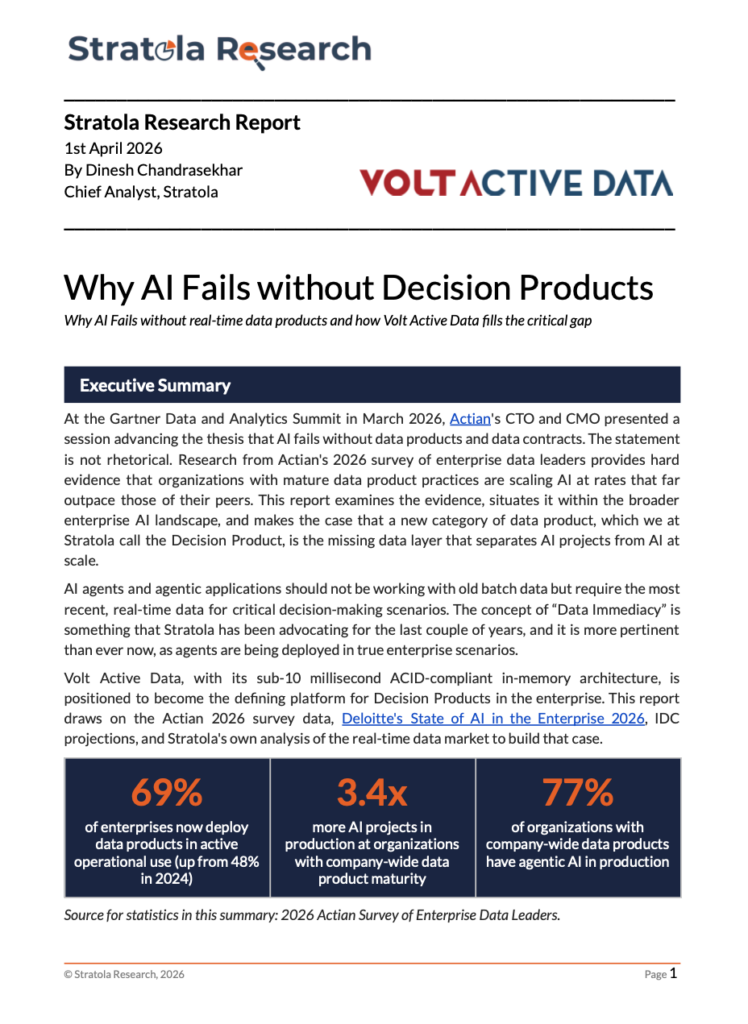
In Chandrasekhar’s report, Why AI Fails Without Decision Products, he draws on Deloitte research showing that only 11% of enterprises have agentic AI actively running in production today, with another 38% stuck in pilot. His diagnosis: the chief obstacle is the inability of traditional data pipelines to support the real-time, stateful, transactionally consistent data access that autonomous agents require.
Chandrasekhar frames this as a failure of data immediacy: most stacks can capture real-time data, but can’t make it available at the moment a decision actually needs to be made. Agents reasoning from stale batch data hallucinate. Agents without transactionally consistent state produce recommendations that can’t be safely acted on.
The gap isn’t in the data. It’s in the last mile to action.
The architectural reason is structural. A typical real-time stack requires five or more system integrations to produce a single decision: a streaming broker, a stream processing engine, a state store, a serving layer, and an application gateway. Each hop adds latency. Each boundary introduces failure modes. The result is a system that moves data at millisecond speed but produces decisions at second-scale latency.
For fraud prevention, that gap means the transaction has already cleared.
For usage enforcement, it means the overage has already happened.
For agentic AI, it means the agent is reasoning from a version of the world that no longer exists.
The report introduces a category of real-time data products specifically designed to close this gap: purpose-built for operational execution, not analytical insight, and operating at sub-10 millisecond latency with full ACID compliance. The report maps out where this category sits in the broader data product maturity model, why the mainstream data platform market has largely left it unaddressed, and what it takes to build one.
Volt closes the gap streaming can’t
Volt Active Data is featured in the report as the platform purpose-built for Decision Products. Agentic AI requires a decisioning layer, not just faster pipelines. Volt collapses the five-layer real-time stack into a single in-memory architecture that delivers sub-10 millisecond, ACID-compliant decisions.
Streaming platforms solve the signal problem. Volt solves the decision problem. The two are not the same thing, and conflating them is precisely why so many agentic AI initiatives are still stuck in pilot.
The Bottom Line
The agentic AI production data gap is not going to close by improving the models. It closes when organizations build the data infrastructure that agents actually require: real-time, governed, transactionally consistent, and capable of returning authoritative decisions rather than analytical approximations.
Chandrasekhar’s report makes the case with hard numbers, a clear framework for where the market stands, and a direct argument for what needs to change. It is worth reading in full.
Read the full Stratola analyst report: Why AI Fails Without Decision Products
Analyst Report
Why AI Fails Without Decision Products
89% of enterprises are still running pilots. See what the other 11% built differently.
What is a decision product and how is it different from an analytical data product?
A decision product is purpose-built for operational execution, not analytical insight. Where analytical data products inform decisions by producing reports, scores, or recommendations, decision products make the system act by providing authoritative, ACID-compliant outputs at sub-10 millisecond latency. The distinction is not semantic: analytical products answer “what happened or what might happen,” while decision products answer “what should happen right now” with enough authority for downstream systems to enforce immediately.
Why does agentic AI fail in production even when real-time data infrastructure exists?
The failure is structural. Most real-time stacks chain five or more systems together to produce a single decision, which introduces compounding latency and failure modes at each boundary. Agents reasoning from stale batch data hallucinate. Agents without transactionally consistent state produce recommendations that cannot be safely acted on. Moving data quickly through pipelines is not the same as providing authoritative decisions at the moment an agent needs them.
What does "transactionally consistent" mean in the context of agentic AI?
Transactional consistency means that when an agent queries operational state during its reasoning process, the data it receives is both current and guaranteed to match the state that any resulting decision will be evaluated against. Without this guarantee, agents may reason from a version of the world that no longer exists by the time they produce a recommendation, leading to hallucinations, incorrect outputs, or decisions that cannot be safely enforced.
What is the agentic AI production data gap?
The production data gap describes the mismatch between what real-time data infrastructure can deliver and what autonomous agents actually require. Most stacks can capture and move real-time data, but cannot make it available at the exact moment a decision needs to be made with full transactional consistency and sub-10 millisecond latency. According to Deloitte research cited in Chandrasekhar’s report, only 11% of enterprises have agentic AI running in production today, with 38% stuck in pilot. The data gap is the primary structural reason.
How does Volt close the gap that streaming platforms leave open?
Streaming platforms solve the signal problem: they move data efficiently and at scale. Volt solves the decision problem by collapsing the five-layer real-time stack into a single in-memory architecture that delivers sub-10 millisecond, ACID-compliant decisions. Where streaming stops at signal delivery, Volt provides the authoritative decision that systems enforce immediately, with full operational state maintained continuously and accessible to agents via MCP tools during their reasoning process.
What are MCP tools and why do agentic AI systems need them?
MCP tools are structured APIs, implemented as stored procedures within Volt, that allow agents to query real-time operational intelligence during their reasoning process. Instead of running blind SQL queries against stale data warehouses, agents call MCP tools and receive authoritative, current responses: account balances, transaction history, active alerts, usage velocity. This eliminates the stale-data hallucinations that are one of the primary reasons agentic AI fails to reach production safely.
How does a decisioning layer support explainability and compliance for AI-assisted decisions?
A decisioning layer captures the complete interaction chain: what signals triggered evaluation, what state was used, what the agent queried via MCP tools, what the agent recommended, what deterministic logic was applied, and what the final decision was. This full audit trail is essential for regulated environments where AI-assisted decisions must be explainable and defensible. Without this capture, organizations cannot meet compliance requirements or use AI-assisted decisions as reliable training data for model retraining.
About Author

Featured Resources