- Field ops spend is a direct, measurable OPEX line, and AI that helps during the visit (not just before) has a clear ROI case.
- Most monitoring systems are built to catch known failures; the dangerous gap is the novel, correlated failure nobody programmed for.
- Agentic AI interest in telecom is specific and real, but production readiness varies considerably across operators.
- The detection gap is structural, not industry-specific. Telco and BFSI are hitting the same wall from different directions.
TL;DR
DTW Ignite brought together network operators, vendors, and systems integrators to talk about where telecom infrastructure is heading. This year we showed up differently than in years past. Together with our partners Binom and Tech Solutio, we ran our first Catalyst, an AI Agent solution built to support field engineers, not just automate around them.
That project, and the conversations it sparked at our booth, told a consistent story. Here’s what we took away.
Field Operations Is Where the Money Actually Is
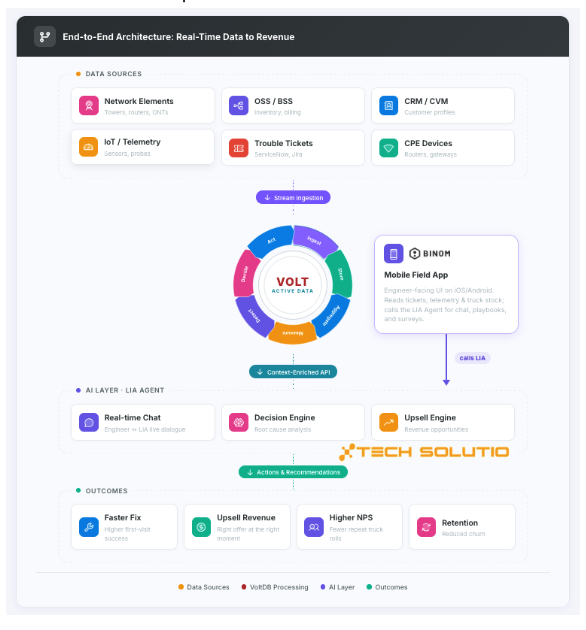
Most Catalyst projects this year focused on ticket automation and avoiding truck rolls entirely. We took a different angle because we know truck rolls can never be reduced to zero. So we built a solution that helps during the visit itself by adding chat-based access to network information directly within the existing field engineer application.
One telco operator put real numbers behind why this matters. With 1.46 million subscribers, they conduct around 2,500 field visits a day, roughly 1,600 fault visits and 900 installations, amounting to an estimated €25 million in annual field-ops spend across labor, vehicles, and parts. As they framed it, every truck roll and every minute onsite is a line item on the P&L. Every avoided truck roll and every minute saved is a direct OPEX impact.
Volt served as the single source of truth for Tech Solutio’s AI Agent, providing field engineers with access to network information via Volt’s MCP server capabilities. The agent drew on multiple live data sources including CRM, core network, WiFi monitoring telemetry, billing systems, and a RAG-based CPE knowledge base, with room to add more over time, such as weather forecasts to flag storms affecting FWA devices.
It resonated because it was a well-defined problem everyone in the room understood, with a direct line to OPEX. Fixing onsite issues faster isn’t an abstraction. It shows up on the bill.
Detection Isn’t the Problem. Noticing Is.
This is where DTW and FinNext Summit, our BFSI event earlier this year, started to rhyme in a way we didn’t expect.
At our booth, a senior product manager at a major North American telco told us about an incident where a developer pushed a DHCP update that quietly stopped releasing IP addresses after lease expiry. Devices went dark. A million customers lost internet. And every monitoring dashboard stayed green, because nothing in the stack was built to notice a slow leak in available IP addresses. It was built to notice things going down, not things quietly running out.
The outage was only caught because engineers’ own home connections stopped working. Someone called their manager, who asked, reasonably, why the NOC hadn’t flagged it. The honest answer was that there was nothing to flag. All systems were green.
It’s nearly the same story we heard from risk teams at a recent BFSI event. They told us that detection systems do work, but they still miss the thing that matters because the signals live across multiple systems. In telco, it’s a DHCP pool slowly running dry. In financial services, fraud is often caught only after the money has already moved.
The product manager’s own answer to this problem, independently arrived at, was close to what Volt is built to do: an AI agent watching a correlated set of KPIs in real time, with a single source of truth underneath it. He mentioned his team is already using Anthropic’s Sonnet and Haiku internally for something adjacent, and he asked directly whether we had an MCP server his engineers could connect to. We do.
Agentic AI Interest Is Real. Production Readiness Is Mixed.
We heard genuine, specific interest in the agentic world at the booth. Not the vague kind, but the kind backed by a particular problem someone is trying to solve. A strategic product manager at an equipment vendor wants to bring agentic detection into DDoS mitigation. An architecture lead at a major operator is exploring a digital twin of the network and is shopping for an existing solution before considering building one in-house, a conversation we have now had in nearly identical form with operators in two different countries.
At the same time, some of the same operators running early agents to monitor their networks told us, unprompted, that high-quality frontier models only became viable toward the end of last year. Awareness lags reality. Several operators are still deciding whether to buy or build, without a clear position on where deterministic control ends and agentic reasoning begins. This is the same 90/10 question from FinNext, dressed in telco-specific clothing.
The Same Gap in Two Industries
Walking away from DTW, the similarities to FinNext were hard to miss. The conversations pointed to two different verticals sharing the same underlying problem. Organizations have invested heavily in systems that detect known failure modes, and those systems work exactly as designed. What they don’t do is correlate signals across silos to catch the failure mode nobody explicitly programmed for. In BFSI, that gap shows up as fraud that clears before anyone notices. In telco, it shows up as a NOC dashboard that stays green through a million-customer outage.
That’s the architecture conversation we have been having over and over this year, and it’s the one we’ll keep having because the pattern isn’t industry-specific. It’s structural.
What is a Catalyst project at DTW Ignite?
A Catalyst is a collaborative proof-of-concept run at TM Forum’s DTW Ignite event, where vendors and operators build and demonstrate solutions to real industry problems together.
How does Volt Active Data support agentic AI in telecom?
Volt serves as a real-time single source of truth, providing AI agents with low-latency access to correlated data across network, billing, CRM, and telemetry systems via its MCP server capabilities.
What is the "detection vs. noticing" gap in telecom networks?
Most monitoring systems are designed to detect known failure modes, alerts and thresholds that someone already anticipated. The gap is in correlating signals across silos to catch the failure nobody explicitly programmed for, such as a DHCP pool slowly running dry while all dashboards stay green.
About Author

Featured Resources